
The Market Board is the beating heart of the Final Fantasy XIV economy, and once you understand how it moves, it becomes one of the most reliable ways to earn gil without grinding a single FATE. I have spent more hours than I would like to admit watching prices, and the patterns are very learnable.
Quick answer
- The Market Board is FFXIV’s player-driven auction house; you sell through your retainers and a small sales tax (around 5%, and it varies a little by city) is taken from each sale.
- “Flipping” means buying an underpriced item and relisting it higher; “trading” means crafting or gathering something cheap and selling it where demand is high.
- The biggest, steadiest margins sit on consumables, crafting materials, housing and glamour items, and anything tied to a fresh patch.
- Universalis is the price-history tool most traders use to spot margins before they commit gil.
- Patience and good timing beat undercutting by one gil every few minutes.
If you would rather skip the grind entirely and jump straight to your next big purchase, you can always buy FFXIV Gil and put your time into the content you actually enjoy.
How does the Market Board work in FFXIV?
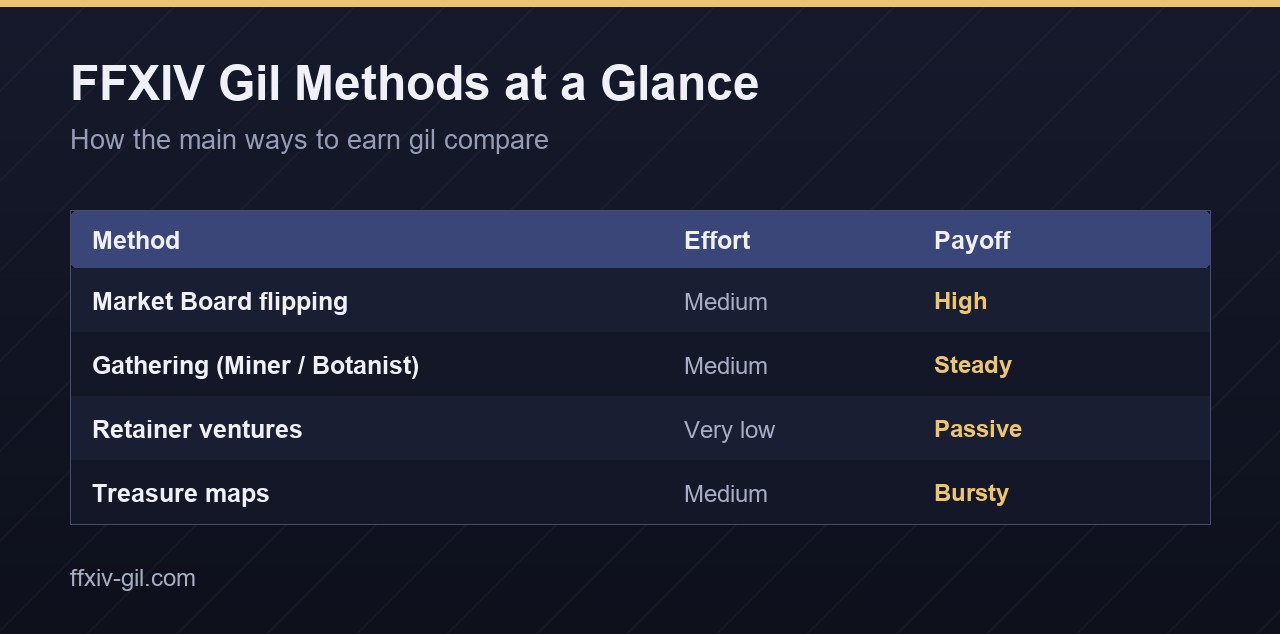
The Market Board is a cross-world auction house where players list items for sale through their retainers. You set the price, the quantity and whether the stack is high quality, and other players buy directly from your listing. A sales tax is deducted when an item sells, so factor that into every price you set.
Each retainer can hold a limited number of listings at once, so treat those slots as valuable real estate: fill them with items that actually move, not with clutter you forgot to clear.
What should you flip on the Market Board?
Flip items where the gap between the lowest listing and the real selling price is wide and repeatable. The categories below tend to offer the most consistent margins.
| Category | Examples | Why it sells |
| Combat consumables | Tinctures, potions, food | Bought constantly for raids and progression |
| Crafting materials | Current-tier mats, crystals, clusters | Crafters need them in bulk every patch |
| Housing & furnishings | Walls, partitions, exterior items | Steady demand from decorators, limited supply |
| Glamour gear | Old dungeon and crafted looks | Fashion never goes out of style |
| Materia | High-demand combat and gathering materia | Needed for melding endgame gear |
The rule of thumb: items that are used up (food, potions, materia) refill demand forever, while cosmetic items ride on trends and patch hype.
How do you read prices without losing gil?
Check the sales history, not just the current listings. A single cheap listing can scare you off an item that normally sells for far more. Tools like Universalis show recent sale prices and how fast an item actually moves across worlds, which tells you whether a “cheap” buy is a real flip or just a slow seller.
A simple checklist before you buy to flip:
- Look at the average sale price over recent history, not the lowest current listing.
- Check how many units sell per day; volume matters more than a big one-time margin.
- Confirm the buy price plus the sales tax still leaves a comfortable profit.
- Avoid items where one player is clearly mass-producing and crashing the floor.
When should you sell?
Demand spikes are predictable. The week a new patch lands, raid consumables and current-tier crafting mats jump as the whole server races through new content. Evenings and weekends usually see more buyers online than weekday mornings. If you craft or gather, prepare stock before the rush, not during it.
Common mistakes that cost you gil
- Undercutting by one gil every few minutes. You train buyers to wait and you crash your own market. Price sensibly and let it sell.
- Listing everything at the floor. Some items are worth holding a day for a better price.
- Ignoring the sales tax. On thin margins it can erase your profit entirely.
- Spreading yourself thin. A few well-chosen items beat fifty random listings.
FAQ
How much gil can you make flipping on the Market Board?
It depends on your starting capital and your market knowledge, but steady traders comfortably clear hundreds of thousands to a few million gil per week once they know which items move.
Do I need a crafter to make gil on the Market Board?
No. Pure flipping and reselling gathered materials work without any crafter, though a high-level crafter or gatherer widens your options considerably.
What is the Market Board sales tax in FFXIV?
A small tax (around 5%, and it varies slightly by city) is deducted from each sale, so always price with that cut in mind.
Why did my item not sell?
Usually it is priced above the current floor, or the item simply has low daily volume. Check the sales history, adjust the price, and be patient rather than slashing it to the bottom.
Is Universalis safe to use?
Universalis is a popular community price-tracking tool that reads public Market Board data. Many traders rely on it to study prices and sales velocity before committing gil.